Last modified: 2003-01-18 by dov gutterman
Keywords: el salvador | nonualcos |
Links: FOTW homepage |
search |
disclaimer and copyright |
write us |
mirrors
See also:
Other sites:
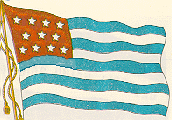
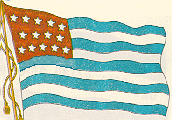
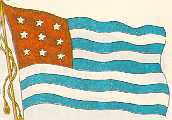
The El Salvadorian Stars and Stripes with 9 stars had a square
canton. It was adopted on 28th April 1865. The law described the
canton as having as many stars as there are provinces, but we
have no records about flags with eleven or thirteen stars (which
would have been possible), but a postage stamp of 1867 shows the
arms with eleven stars and one of 1879 with thirteen stars(!).
With number of stars rising the canton became longer.
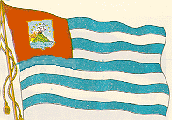
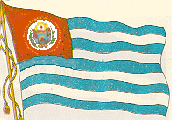
The ensign had the coat of arms in the canton, but only on the
obverse! On the reverse the stars were shown! So it happens that
in the arms there are two flags. Sometimes the great coat of arms
was shown, sometimes a lesser version, sometimes within a white
circle sometimes directy on the red field.
The official name of the state was "El Salvador" since
12 June 1824 but as the Magna Carta of 1824 wrote: "El
Estado se denominar? Estado del Salvador.", the name
"Salvador" was used. From 1896 the name "El
Salvador" was used on postage stamps, on coins it came in
use in 1911, and a decree of 1915 prescribed the name "El
Salvador" always to be written "...de El Slvador"
and not "...del Salvador".
Sources are El Salvadorian literature, official El Salvadorian
Flag book.
Ralf Stelter, 13 June 1999
The evolution of the Salvador flag between 1865 and 1912 seems
to be confuse. Anyway, Znamierowski 'solved' the problem by
showing only the flag with 14 stars as 'Salvador, 1865-1912'.
This is quite approximative because we know the adoption date of
the flag with only 9 stars (28 April 1865) and the year of
creation of the 14th province, 1877.
Ivan Sache, 18 March 2001
While in Washington DC I was very lucky and found the
official newspaper of the goverment of El Salavdor from 1865 as
well as the local Salvadoran newspaper from the same year. I
found the foillowing information in spanish from both
publications: "El Constitucional Periodico Oficial del
Gobierno del jueves 4 de mayo de 1865" and "el diarrio
El Faro del 8 de mayo de 1865".
Here is the law in Spanish of the flag dimensions and the crest:
REPUBLICA DEL SALVADOR EN LA AMERICA CENTRAL
EL CONSTITUCIONAL.
PERIODICO OFICIAL DEL GOBIERNO.
TOMO 1. San Salvador Jueves 4 de mayo de
1865 NUM. 82
PARTE OFICIAL
MINISTERIO DE RELACIONES EXTERIORES E INSTRUCCION PUBLICA.
Decreto del Gobierno designando los colores del pabellon nacional
y atributos del escudo de armas de la República.
El Presidente de la República del Salvador.
Cumplimentando el decreto del Cuerpo Legislativo de 14 de Febrero
último que lo faculta para designar los colores del pabellon
nacional y los atributos del escudo de armas, se ha servido
decretar lo siguiente.
Artículo 1o -- El pabellon nacional se compondrá de cinco fajas
azules y cuatro blancas: el ancho de dichas fajas será de nueve
pulgadas y su longitud de tres á cuatro varas castellanas. En el
ángulo superior inmediato al asta, llevará un cuadro encarnado
de una vara por lado, en el cual se colocarán nueve estrellas
blancas de cinco ángulos salientes cada una, representando los
nueve departamentos de la República.
Art. 2o -- La bandera antedicha será la mercante. La de guerra
tendrá los mismos colores y dimensiones y en el cuadro encarnado
de que se ha hecho mencion, tendrá el escudo de armas de la
República, llevando al reverso las nueve estrellas de los
departamentos.
Art. 3o -- El escudo de armas nacional será el mismo de la
antigua federacion centro americana con las modificaciones
siguientes: 1a. en lugar de los cinco volcanes que representaban
los cinco Estados de la federacion habrá solamente uno en
actividad imitando al Izalco: 2a. en el espacio superiro del
cuadro que debe contener este volcan se colocarán las mismas
nueve estrellas formando semicírculo: 3a. en la base del escudo
aparecerá de un lado y otro el nuevo pabellon de la República:
4a. el gorro de la libertad descansará en la parte en que se
unen los cuernos de la abundancia que descienden por ambos lados
cuadro: 5a. en forma de semicírculo, se leerá entre rayos
luminosos: 15 de Setiembre de 1821, quedando el gorro en el
centro de éste: y 6a. limitará el escudo una franja circular en
cuya circunferencia aparecerá esta leyenda: República del
Salvador en la América Central.
Art. 4o -- El Ministro de Relaciones se encargará del
cumplimiento y publicacion de este decreto.
dado en San Salvador, á 28 de Abril de 1865
Francisco Duenas
El Ministro de Relaciones Exteriores é Instruccion Pública:
Gregorio Arbizú.
Here is the translation of the Artículo 1o which describes the
dimensions of the flag:
Article 1 - The national flag will consist of five blue stripes
and four white ones: the width of each stripe will be nine inches
and its lenght would be of 3 or 4 varas castellanas ( one
vara castellana equals 36 inches) . In the upper corner next to
the flag pole, there will be a red square of one vara (36 inches)
per side, placing nine white five pointed stars,
representing the nine departments of the republic.
So this clears the doubt about the size of the flag and its
components. The red square remained a square as stars were
added, according to the law of 1898 that describes
the flag of the Republica Mayor de Centroamerica and the
one from 1912 they both mentioned that they will
substitute the flag of the 9 stripes with the red square and 14
stars.
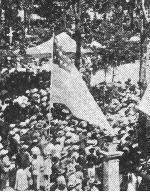
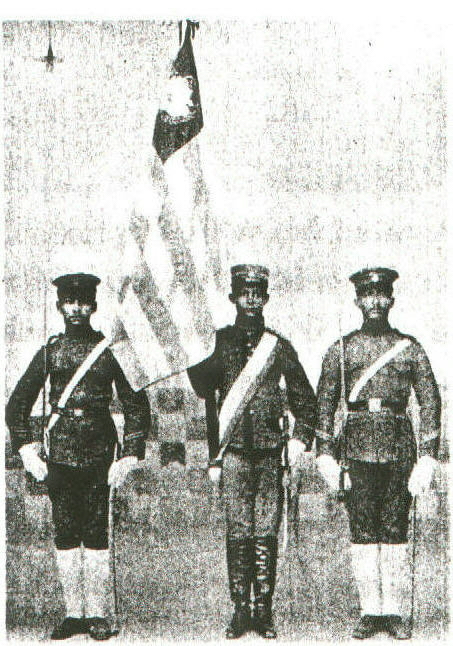
Here is a photo of a flag
with 14 stars used during independence at the celebrations at the
beginning of the century. Also here are images of 9, 11,
12, 13, 14 star flags and also the national ensign and its variant .
Fred Drews, 6 August 2001
According to the law decree that I found , they gave two
official sizes that could be used for the flag.
For the 1877 flag ther one that was officilally use in public
events as shown on the picture taken at the park, but there was
another version that I have seen used on books and a flag that I
have from the period.
On the flags with the coat of arms (National Ensigns), the decree
specifies that the whole coat of arms will be placed on the flag,
but on stamps and coins of the period they show sometimes
the use of the whole coat of arms on a white circle or just part
of the coat of arms.
Fred Drews, 9 August 2001
This leaves me with several questions:
1. What was used between 1821-1865?
I understand that BWB triband was used, or was it? The hirotical
outline is quite complicated for these years, Salvador being part
of the kingdom of Guatemala and this at times federal part of
Mexico, one declaing independence from the other at times... What
was used before 1821, anyway?
2. The 1865 flag is well documented with the legislative
documents, however, I think that the image miht be discussed.
Namely, the Article 1 of the legislation give detailed
construction sheet: 7 stripes of 9" wide, square canton of 1
v.c. (=36") and length of stripes 3 or 4 v.c.
This last is, in my interpretation the description of length of
top four stripes being 3 v.c. and lower 5 stripes of 4 v.c. being
longer for the width of the canton.
Fred Drews interpret this as two possibilities for the overall
ratio, which is not correct, I think. If I am correct that the
overall flag size is 63"x144", i.e. the ratio is 7:16.
(and 63"x108" flag is inexistent). Of course, Fred
might have other reasons for believing there was 3v.c. long flag
of which I am unaware.
Ralf Stelter writes that the ensign had different reverse from
the obverse, namely while on he obverse there was the CoA in the
canton, on the reverse there was stars as in the national flag.
This is almost un-noticable and it might be good to point it
better by placing reverse images next to the overse by each of
the ensigns.
3. Finally, the stars and stripes flag was abandoned in 1912.
Why, what happened then? Just a
"whim"/"nostalgy"? There must have been some
political background. Anyhow, we claim (as does Smith) that the
current BWB triabnd was adopted in 1972. That means that we have
60 years of kind of void. Can anyone fill it in? If the changes
in 1972 legislation are no more then further elaboration of
earlier design, there is no much sence in quoting it as the
adoption date.
Wouldn't something of the sort be better: "Adopted in 1821,
abandoned 1865. Reintroduced 1912, last legislation 27 Sep.
1972." ?
Zeljko Heimer, 8 January 2003
by Fred Drews, 12 November 2002
Fred Drews, 12 November 2002
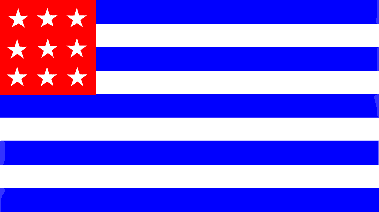
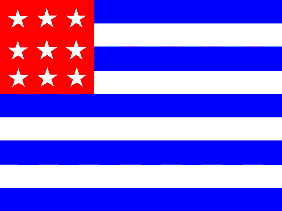
The previous flag of El Salvador (official name), was in
effect from 1865 to 1912. It started with only 9 stars positioned
in rows of 3, 3, 3 in the red canton.
Fred Drews, 9 September 1999
Concerning the 1865 flag, Ralf Stelter's introduction
clearly states that the flag canton was square, although the
preview is a bit ambiguous.
Ivan Sache, 18 March 2001
National Ensigns

by Fred Drews, 12 November 2002
by Fred Drews, 12 November 2002

by Fred Drews, 12 November 2002
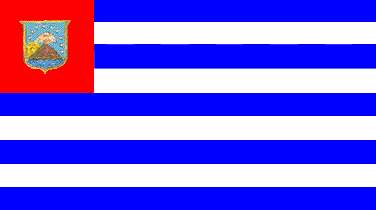
At the time there was in use another flag (the national
ensign), that instead of having the stars in the canton, it had
the coat of arms of that period.
Fred Drews, 9 September 1999
In a photo taken in
1911, there is the flag used by the military during a parade. The
flag shows the red square with the national coat of arms placed
directly on the red and not in a white circle.
Fred Drews, 29 May 2002
Reported Flag
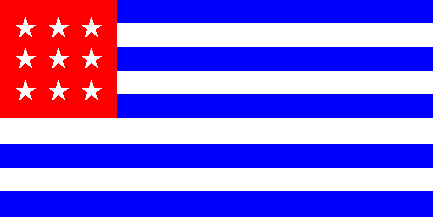
by Ivan Sache, 18 March 2001
Based on image provided by Fred Drews.
Reported National Ensign

by Horta and Ivan Sache, 18 March 2001
I found this flag in a very old encyclopedia, it is part of
the Coat-of-Arms of El Salvador and it's displayed on the right
side of the Coat, on the left side there's another flag (this one
already mentioned above).
Horta, 7 July 1998
The 'National ensign' is not an alternative ensign but the
reverse of the national flag, obverse and reverse of the flag
being placed on either side of the coat of arms according to
Ralf's introduction. I suspect the image should have a proportion
of 1:2 like all of the other flags of that period but I have no
solid evidence for it.
Ivan Sache, 18 March 2001
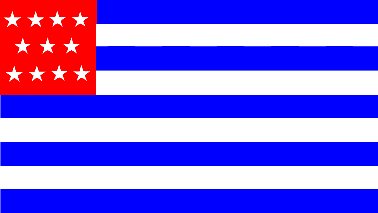
by Fred Drews, 12 November 2002
![[El Salvador - 1869]](../images/s/sv-1869.gif)
by Fred Drews, 12 November 2002
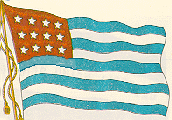
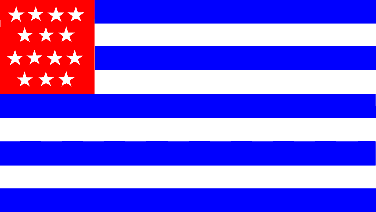
By 1869, 3 more departments were added (2 in June, 1865, and one in February, 1869) increasing then the number of stars to 12, positioned in rows of 4, 4, 4 in the red canton.
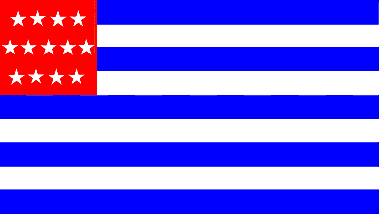
by Fred Drews, 12 November 2002
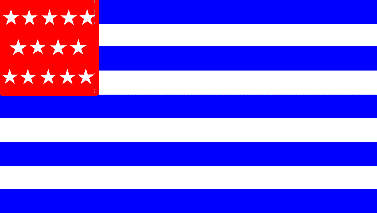
by Fred Drews, 12 November 2002
by Fred Drews, 12 November 2002
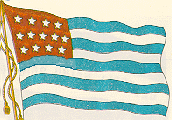
By 1877, 2 more departments were added (one in February, 1873,
and one in February, 1877) increasing then the number of stars to
14, positioned in rows of 4,3,4,3 in the red canton. The flag is
from1875.
Fred Drews, 9 September 1999 and 29 May 2002
A variant of the 4, 3, 4, 3 pattern used a pattern of 5, 4, 5,
as shown by Andrees Handatlas of 1921 (7. Auflage).
Jarig Bakker, 15 January 1999.
![[El Salvador - 1877]](../images/s/sv-1877.gif)
by Ivan Sache, 18 March 2001
The 1877 flag, with 14 stars in canton, is shown by
Znamierowski [zna00) with
proportion 1:2. The porportion seems also to be 1:2 on the
preview of the 1877 coat of arms below.
Ivan Sache, 18 March 2001
1865
by Fred Drews, 24 August 2001
1875
1877.gif)
by Fred Drews, 24 August 2001
1912
by Guadalupe Lindo, 12 October 2002
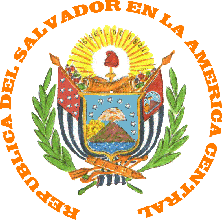
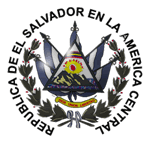
The arms of the period were: a shield containing a volcano in
the middle surrounded by water and on the left side of the shield
the previous flag discussed, and on the right side the same flag
but with the coat of arms in the red canton (I will send a gif of
one in the future).
The red canton has a depth of 5 stripes.
Fred Drews, 25 September 1996
I decided to create the coat of arms exactly as they were
during the period. I took post stamps, tax stamps, coins and post
cards of the late 1800s and begining of the 1900s. All had the
same emblem on them so I created the following coat of arms
from them, which follows the exact description of the law.
Fred Drews, 24 August 2001
In XIX century the indians revolted against conscription and
proclaimed their leader Aquino as king. Kingdom occupated a part
of El Salvador. The full history was published in issue 1 of Flag
Report
Jaume Olle', 3 October 1999