SHAH JAHAN -- THE ARCHITECT
Taj Mahal was built by a Muslim, Emperor Shah Jahan (died 1666 C.E.)
in the memory of his dear wife and queen Mumtaz Mahal at Agra, India.
It is an "elegy in marble" or some say an expression of a
"dream." Taj Mahal (meaning Crown Palace) is a Mausoleum that
houses the grave of queen Mumtaz Mahal at the lower chamber. The grave
of Shah 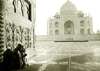 Jahan
was added to it later. The queen’s real name was Arjumand Banu.
In the tradition of the Mughals, important ladies of the royal family
were given another name at their marriage or at some other significant
event in their lives, and that new name was commonly used by the public.
Shah Jahan's real name was Shahab-ud-din, and he was known as Prince
Khurram before ascending to the throne in 1628.
Jahan
was added to it later. The queen’s real name was Arjumand Banu.
In the tradition of the Mughals, important ladies of the royal family
were given another name at their marriage or at some other significant
event in their lives, and that new name was commonly used by the public.
Shah Jahan's real name was Shahab-ud-din, and he was known as Prince
Khurram before ascending to the throne in 1628.
Taj Mahal was constructed over a period of twenty-two years, employing
twenty thousand workers. It was completed in 1648 C.E. at a cost of
32 Million Rupees. The construction documents show that its master architect
was Ustad ‘Isa, the renowned Islamic architect of his time. The
documents contain names of those employed and the inventory of construction
materials and their origin. Expert craftsmen from Delhi, Qannauj, Lahore,
and Multan were employed. In addition, many renowned Muslim craftsmen
from Baghdad, Shiraz and Bukhara worked on many specialized tasks.
The Taj stands on a raised, square platform (186 x 186 feet) with its
four corners truncated, forming an unequal octagon. The architectural
design uses the interlocking arabesque concept, in which each element
stands on its own and perfectly integrates with the main structure.
It uses the principles of self-replicating geometry and a symmetry of
architectural elements.
Its central dome is fifty-eight feet in diameter and rises to a height
of 213 feet. It is flanked by four subsidiary domed chambers. The four
graceful, slender minarets are 162.5 feet each. The entire mausoleum
(inside as well as outside) is decorated with inlaid design of flowers
and calligraphy using precious gems such as agate and jasper The main
archways, chiseled with passages from the Holy Qur’an and the bold
scroll work of flowery pattern, give a captivating charm to its beauty.
The central domed chamber and four adjoining chambers include many walls
and panels of Islamic decoration.
 The
mausoleum is a part of a vast complex comprising of a main gateway,
an elaborate garden, a mosque (to the left), a guest house (to the right),
and several other palatial buildings. The Taj is at the farthest end
of this complex, with the river Jamuna behind it. The large garden contains
four reflecting pools dividing it at the center. Each of these four
sections is further subdivided into four sections and then each into
yet another four sections. Like the Taj, the garden elements serve like
Arabesque, standing on their own and also constituting the whole.
The
mausoleum is a part of a vast complex comprising of a main gateway,
an elaborate garden, a mosque (to the left), a guest house (to the right),
and several other palatial buildings. The Taj is at the farthest end
of this complex, with the river Jamuna behind it. The large garden contains
four reflecting pools dividing it at the center. Each of these four
sections is further subdivided into four sections and then each into
yet another four sections. Like the Taj, the garden elements serve like
Arabesque, standing on their own and also constituting the whole.