HISTORY OF SHAHJAHAN
Shah Jahan assumed the Mughal throne on 24 January 1628 in Agra, a few
days after the death of Jahangir. He inherited 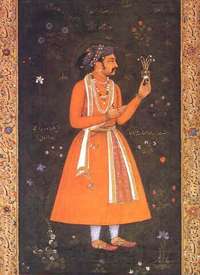 a
vast and rich empire; and at mid-century this was perhaps the greatest
empire in the world, exhibiting a degree of centralized control rarely
matched before. Shah Jahan expanded his empire in all directions: he
annexed the Rajput kingdoms of Baglana and Bundelkhand to the west,
and in 1635 he captured the kingdoms of Bijapur and Golconda in the
Deccan. The king of Bijapur offered some resistance, but was eventually
compelled to capitulate to the Mughal army's superior might. Shah Jahan
also captured petty kingdoms in Kashmir and the Himalayas.
a
vast and rich empire; and at mid-century this was perhaps the greatest
empire in the world, exhibiting a degree of centralized control rarely
matched before. Shah Jahan expanded his empire in all directions: he
annexed the Rajput kingdoms of Baglana and Bundelkhand to the west,
and in 1635 he captured the kingdoms of Bijapur and Golconda in the
Deccan. The king of Bijapur offered some resistance, but was eventually
compelled to capitulate to the Mughal army's superior might. Shah Jahan
also captured petty kingdoms in Kashmir and the Himalayas.
Due to his conquests in the first decade, the empire grew in size and
influence. Encouraged by this, Shah Jahan turned his eyes towards Central
Asia in the 1640s. He fought the Uzbeks in Balkh for several years before
giving up. The other disastrous campaign was against the Safavids of
Persia, who ruled Qandahar. Shah Jahan mounted three campaigns against
the Safavids, but each of them failed completely. Though Balkh and Qandarhar
constituted, in a manner of speaking, the ancestral homeland of the
Mughals, their ambitions were thwarted by the harsh realities of cold
weather, distance, scanty resources, and determined local resistance.