HISTORY OF SHAHJAHAN
Shah Jahan has left behind an extraordinary architectural legacy. It
was at his command that the Taj Mahal was built in 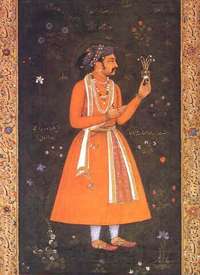 Agra
in memory of his favorite wife, Mumtaz Mahal. This mausoleum, made of
white marble, took seventeen years to complete, and has intricate carvings
and designs. His "Peacock Throne", which was to have a chequered
history in later years, set the tone for a new era of ceremonial display.
It featured precious stones embedded in gold. In 1648, he moved his
court to the newly constructed capital, Shahjahanabad, at Delhi. Shahjahanabad
was a carefully designed courtly city. The emperor's great palace fortress,
Qila Mubarak [Auspicious Fortress], was built on the bank of the river
Yamuna; opposite it stood the grand Mosque, the Jama Masjid, which remains
to this day the largest such structure in India. Shah Jahan kept his
architects and artisans occupied by numerous other ventures.It is certainly
arguable that the Mughal Empire achieved its greatest prosperity under
Shah Jahan. His traditional biographers have suggested that his military
campaigns were organized with diligence, and judging from the hospitals
and rest houses built in his reign, he appears not to have been devoid
of a social conscience. He is said to have donated liberally to the
poor and dispensed justice fairly. Poetry and music flourished in his
reign. Yet it is indisputably clear that he had to exhaust the revenues
of the state, and tax the peasants at exorbitant rates, to satisfy his
craving for monunmental architecture. Nor was he as religiously tolerant
as Akbar or Jahangir and it has been argued that some Hindu temples
were destroyed in his reign. In 1658, Shah Jahan became very ill and,
not unpredictably, a violent battle for succession broke out between
his four sons, Dara Shikoh, Murad, Aurangzeb and Shuja. Though Shah
Jahan favored the liberal Dara Shikoh, who championed a syncretistic
Hindu-Muslim culture, it was Aurangzeb who eventually triumphed in the
succession struggle by methodically eliminating his brothers. Aurangzeb
captured Shah Jahan on 8 June 1658, and had him jailed at the Agra Fort,
from where the old emperor could look wistfully at the glorious Taj.
Shah Jahan died in captivity.
Agra
in memory of his favorite wife, Mumtaz Mahal. This mausoleum, made of
white marble, took seventeen years to complete, and has intricate carvings
and designs. His "Peacock Throne", which was to have a chequered
history in later years, set the tone for a new era of ceremonial display.
It featured precious stones embedded in gold. In 1648, he moved his
court to the newly constructed capital, Shahjahanabad, at Delhi. Shahjahanabad
was a carefully designed courtly city. The emperor's great palace fortress,
Qila Mubarak [Auspicious Fortress], was built on the bank of the river
Yamuna; opposite it stood the grand Mosque, the Jama Masjid, which remains
to this day the largest such structure in India. Shah Jahan kept his
architects and artisans occupied by numerous other ventures.It is certainly
arguable that the Mughal Empire achieved its greatest prosperity under
Shah Jahan. His traditional biographers have suggested that his military
campaigns were organized with diligence, and judging from the hospitals
and rest houses built in his reign, he appears not to have been devoid
of a social conscience. He is said to have donated liberally to the
poor and dispensed justice fairly. Poetry and music flourished in his
reign. Yet it is indisputably clear that he had to exhaust the revenues
of the state, and tax the peasants at exorbitant rates, to satisfy his
craving for monunmental architecture. Nor was he as religiously tolerant
as Akbar or Jahangir and it has been argued that some Hindu temples
were destroyed in his reign. In 1658, Shah Jahan became very ill and,
not unpredictably, a violent battle for succession broke out between
his four sons, Dara Shikoh, Murad, Aurangzeb and Shuja. Though Shah
Jahan favored the liberal Dara Shikoh, who championed a syncretistic
Hindu-Muslim culture, it was Aurangzeb who eventually triumphed in the
succession struggle by methodically eliminating his brothers. Aurangzeb
captured Shah Jahan on 8 June 1658, and had him jailed at the Agra Fort,
from where the old emperor could look wistfully at the glorious Taj.
Shah Jahan died in captivity.