SHAHJAHAN
A good name for Kings is achieved by means of lofty buildings...
From great-great grandfather to father, the Mughals had supported the
arts, setting the precedent for Shah Jahan. He was fascinated by painting
and jewelry,as his father Jahangir had been, and the fine arts flourished
under Shah Jahan as they had in no previous reign. According to art
historian Milo 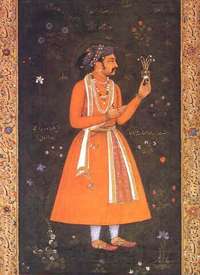 Beach,
"He was well known as a connoisseur of jewels. He had time to dabble
in the arts, and was maybe even a jewel carver himself. But clearly
his real engagement was with architecture." Like his grandfather,
Akbar the Great, Shah Jahan was passionate about architecture. Not content
with the hand-me-down buildings in Akbar's Red Fort, he replaced them
with resplendent palaces of pure white marble. As soon as the Agra Fort
was completed, he moved the Mughal capital from Agra back to the ancient
site of Delhi where he built a magnificent new city, owing nothing to
his ancestors, yet keeping the long-established legacy of the Delhi
throne. (The palaces of Shahjahanabad, now Old Delhi, are also faced
entirely in white marble. Consequently, the reign of Shah Jahan is sometimes
referred to as the "reign of marble.") Heir to an empire that
spanned the sub-continent and beyond, Shah Jahan was also passionate
about dynastic pride and his own celebrity. "Much of his life was
spent demonstrating his power," says Beach. "And because jewels
were the basis for calculating wealth, for confirming that in fact the
Mughals were healthy economically, his power was displayed by means
of a very gaudy display of jewelry." To further enhance his image
as a preeminent ruler, Shah Jahan set aside the six thrones bequeathed
to him by his forebears and commissioned another encrusted with hundreds
of diamonds, emeralds, pearls and rubies - the famous Peacock throne
- where he held court surrounded by exquisite silk carpets and cushions
under arches of silver inscribed in gold. According to Beach, "In
the paintings of Shah Jahan, he's depicted with the coldness of an icon.
European accounts of him at the time talk about him, even as a young
prince, as being very cold, very disdainful and extremely haughty. He's
presented as a symbol of royalty rather than a human being, which separates
him enormously from his father and grandfather, who really delighted
in a personal revelation of their characters. Shah Jahan absolutely
didn't want that. He wanted himself to be seen as the symbol of perfection
- the perfection of a jewel - so carefully crafted and so flawless that
there could be no question at all of the vagaries of a human personality."
Shah Jahan spent incalculable wealth on his preoccupations: a life of
ease, pageantry and pleasure, expeditions to expand his dominion and
the creation of his celebrated edifices. Unlike the buildings of Akbar
which show such eclectic delight in diversity,
Beach,
"He was well known as a connoisseur of jewels. He had time to dabble
in the arts, and was maybe even a jewel carver himself. But clearly
his real engagement was with architecture." Like his grandfather,
Akbar the Great, Shah Jahan was passionate about architecture. Not content
with the hand-me-down buildings in Akbar's Red Fort, he replaced them
with resplendent palaces of pure white marble. As soon as the Agra Fort
was completed, he moved the Mughal capital from Agra back to the ancient
site of Delhi where he built a magnificent new city, owing nothing to
his ancestors, yet keeping the long-established legacy of the Delhi
throne. (The palaces of Shahjahanabad, now Old Delhi, are also faced
entirely in white marble. Consequently, the reign of Shah Jahan is sometimes
referred to as the "reign of marble.") Heir to an empire that
spanned the sub-continent and beyond, Shah Jahan was also passionate
about dynastic pride and his own celebrity. "Much of his life was
spent demonstrating his power," says Beach. "And because jewels
were the basis for calculating wealth, for confirming that in fact the
Mughals were healthy economically, his power was displayed by means
of a very gaudy display of jewelry." To further enhance his image
as a preeminent ruler, Shah Jahan set aside the six thrones bequeathed
to him by his forebears and commissioned another encrusted with hundreds
of diamonds, emeralds, pearls and rubies - the famous Peacock throne
- where he held court surrounded by exquisite silk carpets and cushions
under arches of silver inscribed in gold. According to Beach, "In
the paintings of Shah Jahan, he's depicted with the coldness of an icon.
European accounts of him at the time talk about him, even as a young
prince, as being very cold, very disdainful and extremely haughty. He's
presented as a symbol of royalty rather than a human being, which separates
him enormously from his father and grandfather, who really delighted
in a personal revelation of their characters. Shah Jahan absolutely
didn't want that. He wanted himself to be seen as the symbol of perfection
- the perfection of a jewel - so carefully crafted and so flawless that
there could be no question at all of the vagaries of a human personality."
Shah Jahan spent incalculable wealth on his preoccupations: a life of
ease, pageantry and pleasure, expeditions to expand his dominion and
the creation of his celebrated edifices. Unlike the buildings of Akbar
which show such eclectic delight in diversity, Shah Jahan's constructions demonstrate cool confidence in a new order.
In his structures, the Hindu and Islamic traditions are not simply mixed
but synthesized in a resolved form - the balance of inlaid ornamentation
and unadorned spaces; the cusped arch, neither Islamic nor Hindu; the
simplified columns and brackets created without the rich carvings; the
kiosks with Islamic domes - typical of the nobility, grace and genius
that characterize the constructions of Shah Jahan. For all the beauty
of the embellishments used in the Taj Mahal and his other buildings,
it is the stylistic unity and harmony of design that is Shah Jahan's
greatest accomplishment, providing the finishing touch in the Mughal
style of architecture.
Shah Jahan's constructions demonstrate cool confidence in a new order.
In his structures, the Hindu and Islamic traditions are not simply mixed
but synthesized in a resolved form - the balance of inlaid ornamentation
and unadorned spaces; the cusped arch, neither Islamic nor Hindu; the
simplified columns and brackets created without the rich carvings; the
kiosks with Islamic domes - typical of the nobility, grace and genius
that characterize the constructions of Shah Jahan. For all the beauty
of the embellishments used in the Taj Mahal and his other buildings,
it is the stylistic unity and harmony of design that is Shah Jahan's
greatest accomplishment, providing the finishing touch in the Mughal
style of architecture.