SHAHJAHAN and MUMTAZ MAHAL
On that night, the light of stars and the illuminations of torches and
lanterns shone... a night brighter than the day of 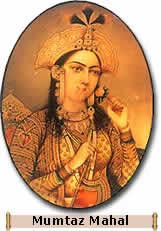 youth,
adding to fulfillment of desire... Prince Khurram, who would become
Shah Jahan, was born in India in the same month as the Prophet Mohammed
in the auspicious year 1,000 of the Islamic calendar (January 15, 1592).
He was named Khurram, which means "joyous," by his doting
grandfather Akbar, who said the birth made the world glad. "He
was born during the height of Akbar's power," says art historian
Shobita Punja, "when most of India came under Mughal rule. He was
very well educated, had brilliant teachers, and was quite an aesthete.
He really was a very cultured human being."
youth,
adding to fulfillment of desire... Prince Khurram, who would become
Shah Jahan, was born in India in the same month as the Prophet Mohammed
in the auspicious year 1,000 of the Islamic calendar (January 15, 1592).
He was named Khurram, which means "joyous," by his doting
grandfather Akbar, who said the birth made the world glad. "He
was born during the height of Akbar's power," says art historian
Shobita Punja, "when most of India came under Mughal rule. He was
very well educated, had brilliant teachers, and was quite an aesthete.
He really was a very cultured human being."
Mumtaj Begam (Arjumand Banu Begam )
was the niece of Noorjahan ( Mehrunisa), who in turn was niece of Akbar's
Persian (Iran) queen Bilgis Begam.
According to one of the youth's companions at court, Prince Khurram
was a handsome youth, "possessed of a sharp wit, a wonderful memory,
a love for details and the capacity to master them." Legend has
it that the young prince charmed Arjumand Banu Begum (later named Mumtaz
Mahal) at the Royal Meena Bazaar during the Moslem New Year festival,
where merchants brought fine cloth, precious jewels and other goods
for the harem and nobles of the court. Though court poets celebrated
the young girl's beauty, no contemporary likenesses of her are known
to exist. According to author and art historian Milo Beach, "There
are paintings that are labeled 'Mumtaz Mahal,' but they are simply generalized
depictions of a Mughal beauty. There's virtually no contemporary account
of her, because none of the historians would have had contact with her."
Under Mohammed's law of "purdah," the law of the veil, women
were obliged to hide their faces from public view. The only women depicted
in paintings were court dancers and entertainers; it was taboo to paint
royal women. "Royal women were kept in seclusion, but that has
nothing to do with the power they held," adds Beach. "They
clearly were extremely powerful. Shah Jahan's father, Jahangir, married
a woman named Nur Jahan who was really the person who ran the empire
for the second half of Jahangir's reign, when he became addicted to
opium and alcohol. He barely functioned as an emperor, and she ran the
country." "We know very little about Mumtaz Mahal except that
she was the daughter of Asaf Khan, who was the Prime Minister for Shah
Jahan and 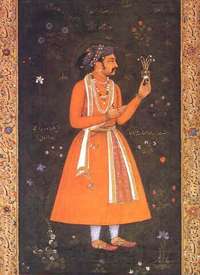 son
of the Prime Minister for Jahangir whose sister, Nur Jahan, married
Jahangir. You cannot be more closely related to the Imperial family
than that. Many of Asaf Khan's cousins and other relatives were also
placed in positions of enormous power in the Mughal court. So Mumtaz
Mahal probably had a very important and influential role in her husband's
life." Before marriage to Mumtaz Mahal, the Emperor Jahangir had
arranged two other marriages for his son for political purposes. But
although Shah Jahan had three regular wives, Mumtaz Mahal became his
favorite and bore his only children. The Prince would not part with
her even on his numerous military campaigns. In his suffering, she sustained
him; in his glory, she inspired him to acts of charity and benevolence.
Both comrade and counselor, she was beloved by him for her unswerving
loyalty and by his people for her wise and compassionate guidance.
son
of the Prime Minister for Jahangir whose sister, Nur Jahan, married
Jahangir. You cannot be more closely related to the Imperial family
than that. Many of Asaf Khan's cousins and other relatives were also
placed in positions of enormous power in the Mughal court. So Mumtaz
Mahal probably had a very important and influential role in her husband's
life." Before marriage to Mumtaz Mahal, the Emperor Jahangir had
arranged two other marriages for his son for political purposes. But
although Shah Jahan had three regular wives, Mumtaz Mahal became his
favorite and bore his only children. The Prince would not part with
her even on his numerous military campaigns. In his suffering, she sustained
him; in his glory, she inspired him to acts of charity and benevolence.
Both comrade and counselor, she was beloved by him for her unswerving
loyalty and by his people for her wise and compassionate guidance.