Taj Mahal Commentary
"A white marble tomb built in 1631-48 in Agra, seat of the Mugal Empire,
by Shah Jehan for his wife, Arjuman Banu Begum, the monument sums up
many of the formal themes that have played through Islamic architecture.
Its refined elegance is a conspicuous contrast both to the Hindu architecture
of pre-Islamic India, with its thick walls, corbeled arches, and heavy
lintels, and to the Indo-Islamic styles, in which Hindu elements are
combined with an eclectic assortment of motifs from Persian and Turkish
sources."
---Marvin Trachtenberg and Isabelle Hyman.Architecture: from Prehistory
to Post-Modernism. 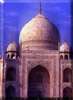
"The Mausoleum of the Taj Mahal at Agra stands in a formally laid-out
walled garden entered through a pavilion on the main axis. The tomb,
raised on a terrace and first seen reflected in the central canal, is
entirely sheathed in marble, but the mosque and counter-mosque on the
transverse axis are built in red sandstone. The four minarets, set symmetrically
about the tomb, are scaled down to heighten the effect of the dominant,
slightly bulbous dome. The mosques, built only to balance the composition
are set sufficiently far away to do no more than frame the mausoleum.
In essence, the whole riverside platform is a mosque courtyard with
a tomb at its centre. The great entrance gate with its domed central
chamber, set at the end of the long watercourse, would in any other
setting be monumental in its own right."
"The interior of the building is dimly lit through pierced marble lattices
and contains a virtuoso display of carved marble. Externally the building
gains an ethereal quality from its marble facings, which respond with
extraordinary subtlety to changing light and weather."
---Sir Banister Fletcher. A History of Architecture.