TRIBUTE TO TAJ
Agra, once the capital of the Mughal Empire during the 16th and early
18th centuries, is one and a half hours by express train from New Delhi.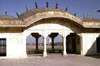 Tourists from all over the world visit Agra not to see the ruins of
the red sandstone fortress built by the Mughal emperors but to make
a pilgrimage to Taj Mahal, India’s most famous architectural wonder,
in a land where magnificent temples and edificies abound to remind visitors
about the rich civilization of a country that is slowly but surely lifting
itself into an industrialized society. The postcard picture of Taj Mahal
does not adequately convey the legend, the poetry and the romance that
shroud what Rabindranath Tagore calls "a teardrop on the cheek of time".
Tourists from all over the world visit Agra not to see the ruins of
the red sandstone fortress built by the Mughal emperors but to make
a pilgrimage to Taj Mahal, India’s most famous architectural wonder,
in a land where magnificent temples and edificies abound to remind visitors
about the rich civilization of a country that is slowly but surely lifting
itself into an industrialized society. The postcard picture of Taj Mahal
does not adequately convey the legend, the poetry and the romance that
shroud what Rabindranath Tagore calls "a teardrop on the cheek of time".
Taj Mahal means "Crown Palace" and is in fact the most well preserved
and architecturally beautiful tomb in the world. It is best described
by the English poet, Sir Edwin Arnold, as "Not a piece of architecture,
as other buildings are, but the proud passions of an emperor’s love
wrought in living stones." It is a celebration of woman built in marble
and that’s the way to appreciate it. Mahal stands on the bank of River
Yamuna, which otherwise serves as a wide moat defending the Great Red
Fort of Agra, the center of the Mughal emperors until they moved their
capital to Delhi in 1637. 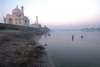
It was built by the fifth Mughal emperor, Shah Jahan in 1631 in memory
of his second wife, Mumtaz Mahal, a Muslim Persian princess. She died
while accompanying her husband in Burhanpur in a campaign to crush a
rebellion after giving birth to their 14th child. The death so crushed
the emperor that all his hair and beard were said to have grown snow
white in a few months. When Mumtaz Mahal was still alive, she extracted
four promises from the emperor: first, that he build the Taj; second,
that he should marry again; third, that he be kind to their children;
and fourth, that he visit the tomb on her death anniversary. He kept
the first and second promises.
Construction began in 1631 and was completed in 22 years. Twenty thousand
people were deployed to work on it. The material was brought in from
all over India and central Asia and it took a fleet of 1000 elephants
to transport it to the site. It was designed by the Iranian architect
Istad Usa and it is best appreciated when the architecture and its adornments
are linked to the passion that inspired it. It is a "symbol of eternal
love".