The Chosen City: Agra
was the chosen city of the Mughal emperors during the early years. It
was here that the founder of the dynasty, Babur, laid out the first
formal Persian garden on the banks of the River Yamuna. Here,  Akbar,
his grandson, raised the towering ramparts of the great Red Fort. Within
its walls, Jehangir built rose-red palaces, courts and gardens. Shahjahan
embellished it with marbled mosques, palaces and pavillions of gem-inlaid
white marble. Agra is globally renown as the city of the Taj Mahal,
a monument of love and imagination, that represents India to the world.
Akbar,
his grandson, raised the towering ramparts of the great Red Fort. Within
its walls, Jehangir built rose-red palaces, courts and gardens. Shahjahan
embellished it with marbled mosques, palaces and pavillions of gem-inlaid
white marble. Agra is globally renown as the city of the Taj Mahal,
a monument of love and imagination, that represents India to the world.
The Taj Mahal is a deserving resting palace for an Emperor's Empress.
It stands on the banks of the river Yamuna, which otherwise serves as
a wide moat defending the Great Red Fort of Agra, the center of the
Mughal emperors until they moved their capital to Delhi in 1637. It
was built by the fifth Mughal emperor, Shah Jahan in 1631 in memory
of his second wife, Mumtaz Mahal, a Muslim Persian princess. She died
while accompanying her husband in Burhanpur in a campaign to crush a
rebellion after giving birth to their 14th child.
 Wonder
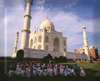
of the World: To people the world over, the Taj Mahal, mausoleum
of Mughal Emperor shah Jana's chief wife, Mumtaz Mahal, is synonymous
with India. Its curving, gently swelling dome and the square base upon
which its rests so lightly is a familiar image from hundreds of brochures
and travel books. The Taj is undoubtedly one of the most spectacular
buildings of the world. Renowned for its architectural magnificence
and aesthetic beauty, it counts among man's proudest creations and is
invariably included in the list of the world's foremost wonders. As
a tomb, it has no match upon earth, for mortal remains have never been
housed in greater grandeur.
Wonder
of the World: To people the world over, the Taj Mahal, mausoleum
of Mughal Emperor shah Jana's chief wife, Mumtaz Mahal, is synonymous
with India. Its curving, gently swelling dome and the square base upon
which its rests so lightly is a familiar image from hundreds of brochures
and travel books. The Taj is undoubtedly one of the most spectacular
buildings of the world. Renowned for its architectural magnificence
and aesthetic beauty, it counts among man's proudest creations and is
invariably included in the list of the world's foremost wonders. As
a tomb, it has no match upon earth, for mortal remains have never been
housed in greater grandeur.