
Last modified: 2001-08-16 by franc van diest
Keywords: frisia | friesland | netherlands |
Links: FOTW homepage |
search |
disclaimer and copyright |
write us |
mirrors
 Shipmate Flagchart : http://www.shipmate.nl/flags.htm
See also:
Tietjerksteradeel/Tytsjerksteradiel lies just east of the Frisian capital,
Leeuwarden. It is mainly a forensic place for people working in Leeuwarden. It
has Dutch renown as a tongue-twister.
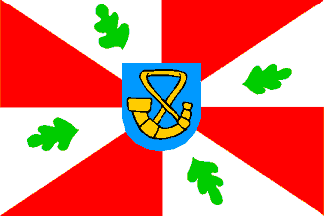
The new flag (adopted 1984?) has retained the red and white colors and the
posthorn (which is thus far some mystery) and added the oakleaf for the woody
environment.
Jarig Bakker, 4 September 1999
The village flags and CoAs of this municipality have been scanned by me from
'Doarpswapens en doarpsflaggen fan de doarpen yn de gemeente Tytsjerksteradiel',
- Village CoAs and village flags in the municipality of Tytsjerksteradiel,
edited by the municipality, Burgum, 1996.
They have been giffed by Gerard van der Vaart (not all). Referring page at FOTW:
<nl-fr-tj.html>
In 1977 there was a corso with decorated carts in the 7 villages of the
'Trynwâlden-quarter' of the municipality (= three forests). For those villages
7 flags and CoAs were designed. Later on there were deliberations between the
'Fryske Rie foar de Heraldyk' (Frisian Heraldic Council), the village local
councils and the municipal Cultural Council, by which in 1986 16 village flags
and CoAs were adopted.
A note on the language: In Dongeradeel the official language is still Dutch,
while Frisian is accepted as second language. In Tytsjerksteradiel (Dutch:
Tietjerksteradeel) the official language seems to be Frisian; hence I use the
Frisian village names here.
Jarig Bakker 05 November 2000
 Shipmate Flagchart : http://www.shipmate.nl/flags.htm
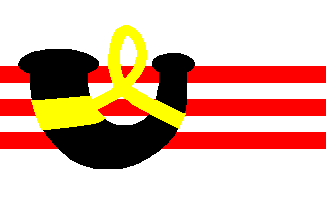
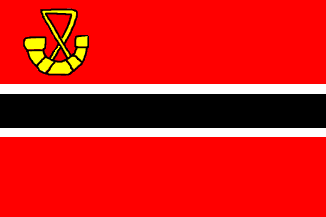
On 6 July 1956 a flag was adopted, consisting of three equally wide horizontal bars; the first and third bar white, the middle bar divided in five equally wide stripes in 3 red and 2 white stripes and toward the hoist a black horn with yellow inlay and cord.
This flag was in use until 1984.
Jarig Bakker, 2 December 1999
 Shipmate Flagchart : http://www.shipmate.nl/flags.htm
Aldtsjerk (Dutch: Oudkerk) is a village with c. 600 inhabitants, most famous
in the Netherlands because of its hamlet 'Bartlehiem', where the big
skating-race, the 'Elfstedentocht' passes, when it is being held.
Flagdescription: 'In wyt krús mei in earmbreedte fan 1/4 flaggehichte, de
fjilden read, grien, grien, read; yn 'e top fan 'e hys in wite dűbele
boskanemoan fan sulver.'
That is: A white cross with an arm length of 1 fourth flagheight; the fields
red, green, green, red; in the hoist top in red a white double wood anemone
(anemone nemorosa).
The cross reminds of the monastery Bethlehem, which was here from 1170 till
1580. There are several stately houses '('staten' or 'stinzen') which have a
remarkable flora. The stins 'De Klinze' has the wood anemone with the double
flowers. The color red has been adopted for the village houses, while green is
for the (fromer) woods around the village.
Jarig Bakker 05 November 2000
 Shipmate Flagchart : http://www.shipmate.nl/flags.htm
 Shipmate Flagchart : http://www.shipmate.nl/flags.htm
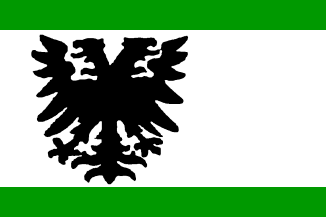
Earnewâld (Dutch: Eernewoude) is a village with c. 400 inhabitants. It is a
very popular watersport-resort.
Flagdescription: Trije hichtebanen fan grien, wyt, grien, yn 'e ferhâlding
1:6:1, yn 'e wite baan op it krús in swarte dűbele earn.
That is: Three horizontal stripes in green, white, green, proportions 1:6:1; in
the white stripe on the cross a black double eagle.
The village CoA is hundreds of years old and contains the eagle, after which the
village was (popularly) named. The color green was chosen to
accentuate the rural character of the village and (as an afterthought) the wood
in the village name.
Jarig Bakker 05 November 2000
 Shipmate Flagchart : http://www.shipmate.nl/flags.htm
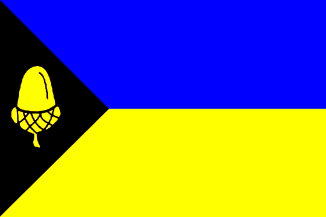
Eastermar (Dutch: Oostermeer) is a village with over 1000 inhabitants south
of the Bergumermeer (lake). In c. 1975 the whole village was awakened by the
arrival of a sailing boat: 'Finally we have become a watersport-resort!' Alas,
so far not really...
Flagdescription: Twa like hege banen fan blau en giel, in griene hysgear oant krús
mei in giele ikel deryn.
That is: Two equally wide horizontal stripes of blue and yellow; a green
hoist-triangle at the cross in which a yellow acorn.
Explanation: The villagers themselves were mainly responsible for the design of
flag and CoA. On the CoA is a stately 'skûtsje', an old flat-beamed sailing
boat. The acorn reminds of the oak-woods around the village, which had economic
interest for the village (and not any more of course: erased)
Jarig Bakker 06 November 2000
 Shipmate Flagchart : http://www.shipmate.nl/flags.htm
Garyp (Dutch: Garijp) has about 2.000 inhabitants. The name of the village
consists etymologically of 'ga' = village land and 'ryp' meaning territory
(perhaps derived from Latin 'ripa', land along water). The village is on the
border of woods and water. Green is for wood, red for the buildings of the
village, white for water.
Flagdescription: fiif hichtebanen fan grien, wyt, read, wyt, grien, yn 'e
ferhâlding 2:1:2:1:2
Jarig Bakker 09 November 2000
 Shipmate Flagchart : http://www.shipmate.nl/flags.htm
Gytsjerk (Dutch: Giekerk) is a village with c. 1000 inhabitants, who are
mainly occupied in agriculture.
Flagdescription: trije likelange banen fan read-giel-read mei yn de giele baan
in griene, út 'e grûn skuorde beam.
That is: Three equally wide vertical bars in RYR with in the yellow bar a green
eradicated tree.
The bars refer to the repartitioning of the village lands and the woody
environment of the village.
Jarig Bakker 06 November 2000
 Shipmate Flagchart : http://www.shipmate.nl/flags.htm
 Shipmate Flagchart : http://www.shipmate.nl/flags.htm
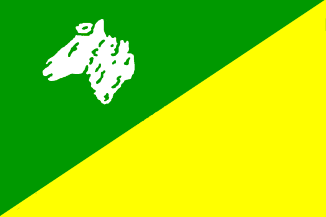
Jistrum (Dutch: Eestrum) has c. 800 inhabitants and a church dating from
1230.
Flagdescription: Flechtskean dield yn grien en giel, yn it grien in wite
skieppekop fan 'e side sjoen.
That is: Per bend fly-wise green and yellow; in green a white sheep's head
facing the hoist.
According to tradition the village name was derived from 'jister' or 'eester' =
enclosure for sheep <my dad only had cattle in the 'jister'>, related to
English 'ewe' - reason enough to include a sheep's head (or should that be a
ewe's head?) on CoA and flag. Green is for the meadows along the Burgumermar;
yellow for the higher lying wheat- and oat-fields.
Jarig Bakker 07 November 2000
 Shipmate Flagchart : http://www.shipmate.nl/flags.htm
Mûnein (Dutch: Molenend) was until 1948 part of the village of
Oentsjerk/Oenkerk; it has about 800 inhabitants. The village mill (moune) gave
it its name.
Flagdescription: gearjend yn acht stikken fan grien en sulver.
That is: gironny eight charges of green and white.
No explanation necessary - but on the village CoA is a splendid old-fashioned
image of the village-mill...
Jarig Bakker 07 November 2000
 Shipmate Flagchart : http://www.shipmate.nl/flags.htm
Noardburgum (Dutch: Noordbergum) has c. 2.000 inhabitants. Formerly this was
heatherland to the north of Burgum; in the 19th century the land became
'cultivated', and in 1930 the two hamlets were joined to form one separate
village. Red is here for the heather. The acorn is derived from the family Ypey
CoA. Green is for the 'cultivation' - and the point of the triangle is for the
destruction of the heather <commendable honesty IMO>
Flagdescription: Read mei in griene hysgear oan it krús ta mei in gouden ikel
yn it griene.
That is: Red with a green hoist-triangle to the cross with a golden acorn in the
green.
Jarig Bakker 09 November 2000
 Shipmate Flagchart : http://www.shipmate.nl/flags.htm
 Shipmate Flagchart : http://www.shipmate.nl/flags.htm
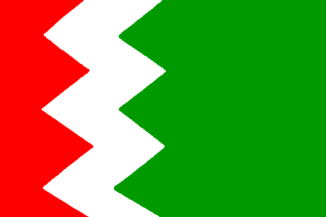
Sumar (Dutch: Suameer) is a village with c. 1500 inhabitants. In the past
here was heatherland, which was cultivated after 1900. In the 19th century the
village was known because of a market held here twice a year, in spring and in
autumn, where sheep and lambs were sold. The red color on the flag reminds of
the heather (in Frisian heraldry the color violet is not used). Green is for the
meadows at present around the village.
Flagdescription: trije takkelige lingtebanen fan read, wyt, grien, yn 'e
ferhâlding 1:1:2, de banen trije kear takkelich.
That is: Three indented vertical bars in red, white, green, proportions 1:1:2,
the bars three times indented.
Jarig Bakker 10 November 2000
 Shipmate Flagchart : http://www.shipmate.nl/flags.htm
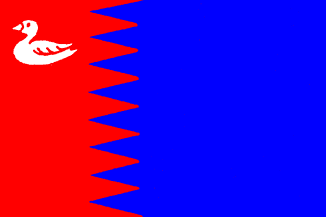
Suwâld (Dutch: Suawoude) is a village with c. 600 inhabitants with a ferry
for pedestrians. It is a long village along the road, west of the Wide Ee water.
The yellow middle stripe symbolizes the sandy soil on which the village is
built; on both sides there were marshlands, where peat was dug, colored black.
The duck reminds of the duck cage which was once near the village.
Flagdescription: trije like lange banen fan swart, giel, swart; yn 'e hystop in
swimmende ein fan sulver.
That is: Three equally wide vertical bars in black, yellow, black; in the hoist
top a swimming white duck.
As all Tytsjerksteradiel flags, these images were made by Gerard van der Vaart
of Shipmate.
Jarig Bakker 10 November 2000
 Shipmate Flagchart : http://www.shipmate.nl/flags.htm
 Shipmate Flagchart : http://www.shipmate.nl/flags.htm
|