|
-- history continued --
Ming (1368-1644 AD)
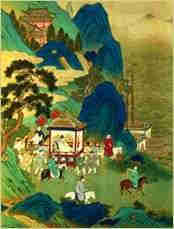 Ming
were the greatest wall builders. Most of what we see today of
the wall are remnants of this dynasty. Ming is ruled by a house
of Chinese who overthrown the Mongols (Yuan dynasty, 1271-1368).
They wanted to make sure "barbarians" never rule over China again.
Hence they were very mistrustful and uncompromising to the foreigners.
Ming forbidded any foreign contact and trading for a while during
16th century. However, because of one of the border officer's defection,
Ming was not able to repel another nomadic people, Manchurian's
invasion. Ming
were the greatest wall builders. Most of what we see today of
the wall are remnants of this dynasty. Ming is ruled by a house
of Chinese who overthrown the Mongols (Yuan dynasty, 1271-1368).
They wanted to make sure "barbarians" never rule over China again.
Hence they were very mistrustful and uncompromising to the foreigners.
Ming forbidded any foreign contact and trading for a while during
16th century. However, because of one of the border officer's defection,
Ming was not able to repel another nomadic people, Manchurian's
invasion.
Appearance of the Wall
Soldiers were aided by architectural features like Buttresses
to defend enemies. Buttresses were blocks that stick up from
the wall at regular intervals, where troops could store equipment.
They were also designed to protect from enemy firing arrows from
below. They included holes though which wall guards could fire on
invaders. The watchtowers were places for the soldiers to live and
keep supplies. They are in sight of at least another tower, to signal
to. On top of the tower, there were crossbows, or later, small cannons.
Life along the Wall
Chinese empires stationed garrisons along the border. They served
in small units, living and working in the watchtowers of the wall.
Their works were mainly keeping an eye for invasions. Soldiers
were equipped with armor, helmets, and heavy crossbow. Each watchtower
had flag or torch to signal if enemy is sighted. Some border
soldiers also work as custom agents, especially along the silk roads.
The 'original' wall was begun in the 9th century B.C. in the
Zhou period, when King Xuanwang built a series of walls and beacon
towers for defense against incursions from northern tribes. In
the Warring States Period (475 - 221 BC), to strengthen defense
against each other, the princedoms built massive walls on the their
borders and linked series of walls and beacon towers into continuous
lines, hence the name "Great wall."
Continued...........
 
|
 |