Bageecha
The Taj Gardens and the Ingenious Water Devices
The Water Devices
The architect who was fully aware of the unaesthetic appearance of the
grotesque pur-ramps and crude conduits, 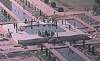 designed
a clever system to procure water for the Taj through underground pipes.
designed
a clever system to procure water for the Taj through underground pipes.
Water was drawn from the river by a series of purs (manual system of
drawing water from a water body using a rope and bucket pulled by bullocks)
and was brought through a broad water channel into an oblong storage
tank of great dimensions. It was again raised by a series of thirteen
purs worked by bullocks. Except for the ramps, the other features of
the whole water system have survived. An over-head water-channel supported
on massive arches carried water into another storage tank of still greater
dimensions. Water was finally raised by means of fourteen purs and passed
into a channel which filled three supply tanks, the last of which had
pipe mouths in its eastern wall. The pipes descended below and after
travelling underground crossed into the Taj enclosure. One pipe line
runs directly towards the mosque to supply the fountains in the tanks
on the red sandstone plinth below the marble structure. Copper pipes
were used for separate series of fountains in the north-south canal,
lotus  pond
and the canal around it.
pond
and the canal around it.
An ingenious method was devised to ensure uniform and undiminished water
pressure in the fountains, irrespective of the distance and the outflow
of water. The fountain pipes were not connected directly with the copper
pipes feeding them as this would have resulted in a gradual decrease
in the volume and pressure of the water. Instead, a copper pot has been
provided under each fountain pipe - which was thus connected to with
the water supply only through the pot. Water first fills the pot and
then only rises simultaneously in the fountains. The fountains are thus
controlled by pressure in the pots and not pressure in the main pipe.
As the pressure in the pots is uniformly distributed all the time, it
ensures equal supply of water at the same rate in all the fountains.
It is really creditable that the planner spared no efforts - belonging
to art, architecture and engineering - to create a perfect production
without the slightest weakness, architectural or aesthetic.The main
supply of the water was however obtained through earthenware pipes.
One such main was discovered under the bed of the western canal. The
pipe is 9" in diameter and has been embedded in masonry at a depth
of 5 feet below the level of the paved walk. Evidently, the mughal water
expert was a master of his art and successfully worked out the levels
in relation to the volume of water to ensure its unobstructed supply
for centuries. He anticipated no repair work and therefore made no provision
for it; hence the extraordinary depth at which the pipe was sunk. The garden is irrigated by the overflowing of canals. The north-south
canal has inlets of water through fountains. The east-west received
its water through an interconnection with the north-south canal. Thus
the quarters near the canals received an adequate supply of water and
could be used for growing flower-plants which would not obscure the
general view, while the distant quarters got a smaller supply of water
and were suitable only for tall trees .
The garden is irrigated by the overflowing of canals. The north-south
canal has inlets of water through fountains. The east-west received
its water through an interconnection with the north-south canal. Thus
the quarters near the canals received an adequate supply of water and
could be used for growing flower-plants which would not obscure the
general view, while the distant quarters got a smaller supply of water
and were suitable only for tall trees .