MUGHAL MONARCHS
An Introduction to the Mughal Dynasty and Mughal Agra
Shah Jehan
Jehangir's son and successor, Shah Jehan ruled from 1628 to 1658. He
was a great patrons of the arts, and Mughal painting and architecture,
blending Persian and Indian traditions, 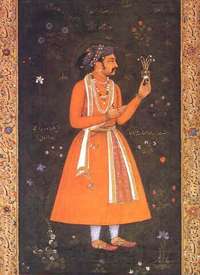 reached
their zenith at this time.
reached
their zenith at this time.
With the accession of Shah Jehan to the throne, came a flowering of
architecture both in Agra and Delhi. The profusion of white marble buildings
raised during the period of Shah Jehan, led one scholar to characterise
it as the reign of marble. Red sandstone and brick remained major building
materials, but the use of marble is expressive of the very high standards
of elegance and luxury that governed all aspects of an architectural
project throughout Shah Jehan's reign. The innovations seen in the buildings
created during Shah Jehan's reign are striking demonstrations of the
effect of particular aesthetic and political concerns. In addition to
a greater use of marble, which was a textural quality quite distinct
from the red sandstone favoured by his predecessors, there was refinement
of the architectural vocabulary. Among specific changes were the introduction
of cusped arches and of pillars with tapering shafts and baluster detailing.
Many developments can be directly related to a desire to articulate
more forcefully paradisiacal and imperial theme, drawing on sources
that included European motifs.
Shah Jehan had many earlier structures in the Agra Fort dismantled in
order to make room for his own marble pavilions. It seems that immediately
upon his accession in 1628, Shah Jehan ordered palace additions to the
existing forts at Agra and Lahore. The most notable complex of white
marble palace structures is situated on the eastern edge of the fortified
walls built by Akbar bordering the Yamuna river. Among these is Muthamman
Burg (Jasmine Tower), built at a point where the main north-south wall
of the fort takes a turn towards the east. The octagonal room, which
offers an 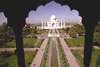 exceptional
view of the Taj Mahal, is supposed to be the place where Shah Jehan
died in 1666. The Muthamman Burg is connected with a series of other
marble pavilions forming the east side of a large courtyard that once
contained a garden. Only the structure and not the flora survives today.
To the north of the palace quarters bordering the garden are additional
rooms including the Hall of Private Audience, which is a marble pillared
hall decorated with profuse inlay. The Shish mahal which is located
close to the royal apartments, has hundreds of small mirrors embedded
in stucco decorations, in intricate floral and geometrical designs.
Some distance away is the magnificent Moti Masjid, the Pearl Mosque
built at an elevation so that its ethereal domes and kiosks are visible
above the walls of the fort.
exceptional
view of the Taj Mahal, is supposed to be the place where Shah Jehan
died in 1666. The Muthamman Burg is connected with a series of other
marble pavilions forming the east side of a large courtyard that once
contained a garden. Only the structure and not the flora survives today.
To the north of the palace quarters bordering the garden are additional
rooms including the Hall of Private Audience, which is a marble pillared
hall decorated with profuse inlay. The Shish mahal which is located
close to the royal apartments, has hundreds of small mirrors embedded
in stucco decorations, in intricate floral and geometrical designs.
Some distance away is the magnificent Moti Masjid, the Pearl Mosque
built at an elevation so that its ethereal domes and kiosks are visible
above the walls of the fort.