Approach to the Taj:
The walled complex is approached from the south through a  red
sandstone forecourt, Chowk-i Jilo Khana, whose wide paths, flanked by
arched kiosks, run to high gates in the east and west. The original
entrance, a massive arched gateway topped with delicate domes and adorned
with Koranic verses, stands at the northern edge of Chowk-i Jilo Khana,
directly aligned with the Taj, but shielding it from the view of those
who wait outside. Today's entrance, complete with security checks, is
through a narrow archway in the southern wall to the right of the gate.
red
sandstone forecourt, Chowk-i Jilo Khana, whose wide paths, flanked by
arched kiosks, run to high gates in the east and west. The original
entrance, a massive arched gateway topped with delicate domes and adorned
with Koranic verses, stands at the northern edge of Chowk-i Jilo Khana,
directly aligned with the Taj, but shielding it from the view of those
who wait outside. Today's entrance, complete with security checks, is
through a narrow archway in the southern wall to the right of the gate.
Garden mausoleum:
The mighty marble tomb stands at the end of superb gardens designed
in the charbagh style so fashionable among Moghul, Arabic and Persian
architects. Dissected into four quadrants by waterways, they evoke the
Islamic image of the Gardens 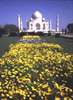 of
Paradise, where rivers flow with water, milk, wine and honey. The "rivers"
converge at a marble tank in the centre that corresponds to al-Kawthar,
the celestial pool of abundance mentioned in the Koran. Today only the
watercourse running from north to south is full, and its precise, glassy
reflection of the Taj is a favourite photographic image.
of
Paradise, where rivers flow with water, milk, wine and honey. The "rivers"
converge at a marble tank in the centre that corresponds to al-Kawthar,
the celestial pool of abundance mentioned in the Koran. Today only the
watercourse running from north to south is full, and its precise, glassy
reflection of the Taj is a favourite photographic image.
The Structure: Essentially square
in shape, with peaked arches cut into its sides, the Taj Mahal surmounts
a square marble platform marked at each corner by a high minaret. Topped
with a huge central dome, it rises for over 55m, its height accentuated
by a crowning brass spire, itself almost 17m high. On approach, the
tomb looms ever larger and grander, but not until you are close do you
appreciate both its awesome magnitude and the extraordinarily fine detail
of relief carving, highlighted by floral patterns of precious stones.
Carved vases of flowers including roses, tulips and narcissi, rise subtly
out of the marble base, a pattern repeated more colourfully and inlaid
with precious stones around the four great arched recesses (pishtaqs)
on each side.
The Tomb: The south face of the
tomb is the main 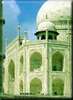 entrance
to the interior: a high, echoing octagonal chamber flushed with pallid
light reflected by yellowing marble surfaces. A marble screen, cut so
finely that it seems almost translucent, and decorated with precious
stones, scatters dappled light over the cenotaph of Mumtaz Mahal in
the centre of the tomb, and that of Shah Jahan next to it. Inlaid stones
on the marble tombs are the finest in Agra; attendants gladly illuminate
the decorations with torches. The 99 names of Allah adorn the top of
Mumtaz's tomb, and set into Shah Jahan's is a pen box, the hallmark
of a male ruler. These cenotaphs, in accordance with Moghul tradition,
are only representations of the real coffins, which lie in the same
positions in an unadorned and humid crypt below that's heavy with the
scent of heady incense and rose petals.
entrance
to the interior: a high, echoing octagonal chamber flushed with pallid
light reflected by yellowing marble surfaces. A marble screen, cut so
finely that it seems almost translucent, and decorated with precious
stones, scatters dappled light over the cenotaph of Mumtaz Mahal in
the centre of the tomb, and that of Shah Jahan next to it. Inlaid stones
on the marble tombs are the finest in Agra; attendants gladly illuminate
the decorations with torches. The 99 names of Allah adorn the top of
Mumtaz's tomb, and set into Shah Jahan's is a pen box, the hallmark
of a male ruler. These cenotaphs, in accordance with Moghul tradition,
are only representations of the real coffins, which lie in the same
positions in an unadorned and humid crypt below that's heavy with the
scent of heady incense and rose petals.