|
THE TAJ MAHAL, & INDIA'S
HISTORY, LEFT TO ROT
The decline of the Taj Mahal through pollution
and apathy is only part of the disappearance of India's past,
writes Luke Harding in New Delhi.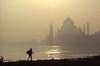
The slow and toxic death of the Taj Mahal has been evident for some
time. India's most celebrated monument, with its sweeping views
over the Yamuna River, is these days more off-white than white.
If the tens of thousands of visitors who pour into the mausoleum
every day were not enough, there are 1,700 factories in the Agra
area, which ensure that pollution levels are kept nicely topped
up.
Revisiting the Taj over the weekend, for the first time in 13 years,
the full horrific scale of the problem became apparent. Were Shah
Jahan to turn up now, three and a half centuries after the grandiloquent
monument to his late queen was completed, he would be in for a bit
of a shock. Jahan, who ended his days imprisoned in Agra's Red Fort,
might conclude the Taj had lost some of its transcendent purity.
 The
problem of pollution is currently made worse by the fact that India
is in the grip of the festival season. For Muslims, it is Urs, when
pilgrims traditionally visit a succession of Moghul and Sufi sites,
arriving in coaches laden with purple plastic tricycles. For Hindus,
it is almost Diwali - the Hindu equivalent of Christmas - when firecrackers
are let off, sending even more fumes into the sky. The
problem of pollution is currently made worse by the fact that India
is in the grip of the festival season. For Muslims, it is Urs, when
pilgrims traditionally visit a succession of Moghul and Sufi sites,
arriving in coaches laden with purple plastic tricycles. For Hindus,
it is almost Diwali - the Hindu equivalent of Christmas - when firecrackers
are let off, sending even more fumes into the sky.
Unless India reacquaints itself soon with its own brilliant architecture,
much of its great past will be erased.
 
|