|
-- history continued --
Wall of Han dynasty
The fall of the Qin dynasty was followed by the
founding of the Western Han dynasty in 206 B.C. It was not until
the reign of Emperor Wu (140-87 B.C.) that the Han court,
after having kept to a policy of economic recuperation for several
decades, launched powerful counterattacks against the Xiongnu and
drove them north of the Great Desert in Mongolia. Then the court
started a major renovation of the Qin wall along the Yellow River,
extending it to the far west. Passing Jiuquan and Dunhuang in
Gansu, the Han Great Wall reached into present-day Xinjiang, then
known as part of the "Western Regions." Fortified castles were
erected along the wall and troops were stationed there. All through
the first century of the Christian era tremendous amounts of manpower
were invested in the building of forts and beacon towers in today's
Shaanxi, Shanxi and Hebei. Standing five kilometers apart, these
installations formed a defence line inside the wall.
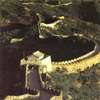 With
Central Asia under Han control, safe caravan routes -- the legendary
Silk Road -- were established, opening China to the commerce
and culture of the Western world. Traders from Rome, Antioch,
Baghdad and Alexandria trekked eastward to deal in jade, gold, spices,
horses, precious gems and of course, silk. With
Central Asia under Han control, safe caravan routes -- the legendary
Silk Road -- were established, opening China to the commerce
and culture of the Western world. Traders from Rome, Antioch,
Baghdad and Alexandria trekked eastward to deal in jade, gold, spices,
horses, precious gems and of course, silk.
Vibrant market towns soon flourished at these safe
and busy gates, where traders from far-flung lands exchanged knowledge
and ideas along with their goods. The world was changing, becoming
smaller, and the Great Wall was playing a vital role.
Continued...........
 
|
 |