The Main Gateway:In
this courtyard stand the main gateway to the Taj and its gardens, a
massive portal that opens to the south. Detached 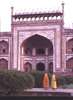 gateways
were long a traditional feature of Muslim architecture and could be
found fronting tombs and mosques throughout the East. Symbolically to
the Muslim, such an entrance way was the gate to paradise. Metaphysically,
it represented the transition point between the outer world of the senses
and the inner world of the spirit.
gateways
were long a traditional feature of Muslim architecture and could be
found fronting tombs and mosques throughout the East. Symbolically to
the Muslim, such an entrance way was the gate to paradise. Metaphysically,
it represented the transition point between the outer world of the senses
and the inner world of the spirit.
The Gateway Structure: Made of red
sandstone, this 150 ft. wide and nearly 100 ft. high, gateway consists
of a lofty central arch with double storeyed wings on either side. Octagonal
towers are attached to its corners which are surmounted by broad impressive
open domed kiosks. The most important feature of the gateway however
is the introduction of a series of eleven attached chhatris (umbrellas)
with marble cupolas, flanked by pinnacles, above the central portal
on the north and south sides. A heavy door at the base is made from
eight different metals and studded with knobs. Inside are countless
rooms with hallways that wind and divide in such apparent abandon that
they seem intentionally built to confuse; perhaps they were, for they
have remained unused for three centuries and their purpose has long
confounded the experts. Within the archway of this majestic entrance,
there is a large chamber 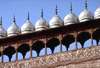 with
a vaulted roof decoration
with
a vaulted roof decoration
The gateway is richly embellished. Of particular note are the floral
arabesques fashioned from gemstones and inlaid in while marble which
decorate the spandrels of the arches. Also impressive are the inlaid
black marble inscriptions that frame the central vaulted portal or iwan.
These passages are excerpts from the Koran, which is considered by Muslims
to be the word of God as revealed to Mohammed. It is here that Shah
Jehan's calligraphers have performed an amazing optical trick : the
size of the lettering that runs up and over the arch appears to be consistent
from top to bottom. This illusion was created by gradually heightening
the size of the letters as their distance from the eye increased; from
the ground the dimensions seem the same at every point. This ingenious
trompe l'oeil effect is used with equal success on the main doorway
of the Taj itself.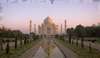 It is said that upon first beholding the Taj through this gateway it
will look small and far away, as if built in three-quarter scale. This
is another optical trick. As one approaches, the illusion turns into
another illusion: the building begins to grow, and continues to grow
until, when the base is reached, it looms colossal. The dome especially
seems to expand as one comes near, almost as if it were being slowly
inflated.
It is said that upon first beholding the Taj through this gateway it
will look small and far away, as if built in three-quarter scale. This
is another optical trick. As one approaches, the illusion turns into
another illusion: the building begins to grow, and continues to grow
until, when the base is reached, it looms colossal. The dome especially
seems to expand as one comes near, almost as if it were being slowly
inflated.