The tradition of hardstone carving had existed for a
longtime in India and the Islamic courts of Iran and central Asia. The
 Taj
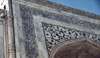
Mahal walls display exquisitely carved floral sprays sculpted in shallow
relief in white marble. The superb quality of the sculpted flowers on
the mausoleum can be attributed to the ancient tradition of stone carving
in India. Engravings in European herbal books that had been brought
into India by foreign visitors inspired their naturalistic forms.
Taj
Mahal walls display exquisitely carved floral sprays sculpted in shallow
relief in white marble. The superb quality of the sculpted flowers on
the mausoleum can be attributed to the ancient tradition of stone carving
in India. Engravings in European herbal books that had been brought
into India by foreign visitors inspired their naturalistic forms.
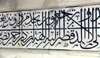
The calligraphy on the Taj was carefully selected and artistically inscribed
in the Mosque and the tomb proper, in panels around the arched portals
and in alcoves and niches. These are mostly verses of the Quran, the
word of God as revealed to Muhammad.
Muslims constitute 11 percent of the population and are the largest
religious minority. Many of these followers of the monotheistic faith
of Islam are descendants of Middle East and Central Asians who began
entering the subcontinent as early as the 8th century. Most, however,
are descendants of converts from Hinduism and other faiths.
 The
lettering of the Quranic calligraphy on the Taj appears to be the same
from top to bottom. This amazing optical illusion was created by Shah
Jehan's calligraphers who gradually heightened the size of the letters
as their distance from the eye increased. From the ground the dimensions
seem to be the same at every point. This ingenious Trompe L'oeil (Trick
of the Eye) effect is also used on the main gateway arch of the Taj.
The
lettering of the Quranic calligraphy on the Taj appears to be the same
from top to bottom. This amazing optical illusion was created by Shah
Jehan's calligraphers who gradually heightened the size of the letters
as their distance from the eye increased. From the ground the dimensions
seem to be the same at every point. This ingenious Trompe L'oeil (Trick
of the Eye) effect is also used on the main gateway arch of the Taj.
Inside the Mosque are inscribed all fifteen verses of Surah 91, entitled
'Wa-Shams' (The Sun) and all four verses of Surah 112 entitled 'Surah
Ikhlas' (The Purity of Faith).