The Quranic inscriptions:
The main gateway has along its front and sides, the whole chapter 89
'Wal-Fajr' (The Daybreak- containing 30 verses), chapter 93 'Wa-duha'
(11 verses), chapter 95 'Wa-tin' (The Fig-8 verses), and chapter 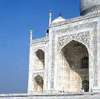 94
'Alam-nashrah' (The Solace-8 verses).
94
'Alam-nashrah' (The Solace-8 verses).
The doors of the main tomb are adorned with the text of Surah 36 entitled
'Ya-Sin' (containing 83 verses). Arched niches on the inside have verses
from Surah 81 'Itha Shamsu Kuwwirat' (The Folding Up), Surah 82 'Itha
Samaaun Fatarat' (The Cleaving Asunder), Surah 84 'Itha Samaun Shaqqat'
(The Rending Asunder) and Surah 98 'Lam Yankunul Kafaru' (The Evidence).
In the mortuary hall, around the frieze and arched niches are inscribed
verses from Surah 67 'Mulk' (Dominion), Surah 48 'Fath' (Victory), Surah
77 'Mursalaat' (Those Sent Forth) and Surah 39 'Zumar' (The Crowds).
Besides these Quranic verses, Persian inscriptions are found inlaid
between stylized floral patterns on the tombs. On Mumtaz's tomb is written:
"Here lies Arjumand Banu Begum called Mumtaz Mahal who died in
1040 Hijri" At the head of the tomb: "He is the Everlasting:
He is Sufficient" and from the Quran - "God is He, besides
whom there is no God. He Knoweth what is concealed and what is manifest.
He is Merciful and Compassionate." On one side: "Nearer unto
God are those who say 'Our Lord is God.'"
<The tomb of Shah Jehan placed next to Mumtaz's after his death reads,
" The illustrious sepulchre and sacred resting place of his majesty...
Shah Jehan, the king valiant. May his tomb ever flourish, and may his
abode be in the heavens. He traveled from this transitory world to the
world of eternity on the night of the 28th of the month of Rajab"
The tombstones and the cenotaphs also bear a few verses from chapters
40,41,83,2,59,39,3 and 23. They have very carefully been selected for
the place and depict the realities of life and death.
Incised painting was an artistic technique created by laying a think
layer of color pigment (hirmich red earth) over the white (safeda white
lead) plaster surface. A floral or conventional design is drawn on the
color surface that is then scraped off. This exposes the white plaster
underneath showing the design drawn. Incised painting is mostly found
along the whole interiors of the Taj Mahal, the Mosque and the rest
house, even on some ceilings. The white background shows through the
scraped off leaves, flowers and outlines. Parts of the background have
thus artistically been brought to the foreground and the foreground
recedes into background!
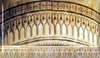 The
outside of the Taj Mahal is a harmonious balance of ornamented and unadorned
surfaces, including intricate floral and geometric inlays, profuse surface
detailing by reliefs, and the exquisitely rendered calligraphic panels.
Although geometric patterns appear, such as the ripple pattern inlaid
in the terrace floor, floral designs are the dominant decorative motifs.
The
outside of the Taj Mahal is a harmonious balance of ornamented and unadorned
surfaces, including intricate floral and geometric inlays, profuse surface
detailing by reliefs, and the exquisitely rendered calligraphic panels.
Although geometric patterns appear, such as the ripple pattern inlaid
in the terrace floor, floral designs are the dominant decorative motifs.