The Mughal Rulers
The Taj Mahal’s Influences
From a religious perspective Shahjahan did not go as far as Akbar did
in attempts to bridge cultural and religious gaps in India.  In
fact, his concern was uniting the region under Sunni Islam, especially
as a protection against the influence of the Safavids in Iran who were
Shiite. But as the biggest patron of architecture, one might say that
his buildings were a way of metaphorically overcoming cultural and religious
differences. His most famous building is the Taj Mahal in Agra. According
to M.C. Joshi in Taj Mahal "The Taj marks the culmination of Mughal
architecture and expresses a synthesis of various structural traditions"
(p. 221). These traditions include Persian and Central Asian as well
as Pre-Mughal Indian architecture, although one can even find European
motifs in the details. Several of the elements can be attributed to
Persian traditions. One such element is the chaharbagh, the four quartered
garden, that was placed in front of the actual mausoleum which we call
the Taj Mahal.
In
fact, his concern was uniting the region under Sunni Islam, especially
as a protection against the influence of the Safavids in Iran who were
Shiite. But as the biggest patron of architecture, one might say that
his buildings were a way of metaphorically overcoming cultural and religious
differences. His most famous building is the Taj Mahal in Agra. According
to M.C. Joshi in Taj Mahal "The Taj marks the culmination of Mughal
architecture and expresses a synthesis of various structural traditions"
(p. 221). These traditions include Persian and Central Asian as well
as Pre-Mughal Indian architecture, although one can even find European
motifs in the details. Several of the elements can be attributed to
Persian traditions. One such element is the chaharbagh, the four quartered
garden, that was placed in front of the actual mausoleum which we call
the Taj Mahal.
While most Mughal tombs were placed in the center of the garden (like
the Tomb of Humayun) this one was placed at the end with a gatehouse
opposite it. This would seem to give this monument an even grander and
more majestic quality as one makes their approach to it from quite a
distance away and can better appreciate it. Islamic gardens are often
called Paradise gardens as they represent man’s interpretation
of heaven based on depictions in the Quran. The architects of this monument
perhaps took this one step further with the inclusion not only of this
garden but of many inscriptions of those Quranic Paradise depictions
which ornament the mausoleum. Some historians feel that this entire
complex was not just a monument dedicated to Shahjahan’s wife but
was meant to be an allegorical representation of the Throne of God and
the gardens of Paradise. Other Persian elements include the irregular
octagonal plan, the half and double 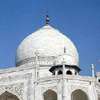 domes,
and grand apses and alcoves.
domes,
and grand apses and alcoves.
Despite these many singular Persian contributions, the overall structure
is said to be Mughal Indian and derived from the Akbari style, which
first developed during Akbar’s rule. This is how many of the elements
which appear to be Central Asian became part of the Taj Mahal’s
design. But more conspicuous than those are the Pre-Islamic Indian elements.
Some of these are what you might see on Hindu temples and include chhatris
(elements that top towers, usually with a dome), guldastas (flower-like
elements), and the use of an inverted lotus to decorate the tops of
the structures. A European element that would be much less noticeable
would be the popular flowering plant motif that was borrowed from engravings
for European herbals.
It may not be so obvious at first sight, especially when that first
sight tends to be so overwhelming, but the Taj Mahal represents a fusion
of many different cultures. Rather than completely subjugate and eradicate
the Pre-Islamic culture of India, early Mughal rulers like Akbar chose
instead to assimilate. Although that may not have lasted, those attempts
are apparent in the architecture; especially monuments like the Taj
Mahal, which today appeals to so many cultures. If that kind of synthesis
were as easily accomplished in reality as it is in architecture then
the world would be a very different and much more beautiful place.