The surroundings of the Taj Mahal have been restored to the original
designs of Ali Mardan Khan, a noble at Shah Jahan's court. The main
vista is accentuated by a red sandstone channel set between rows of
cypress trees. 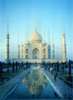
The main entrance is from the west, but there are two other entrances
-- from the east and from the west. The main gateway is a large three-storey
sandstone structure with an octagonal central chamber with smaller rooms
on each side. The walls are inscribed with verses from the Quran. The
Makrana white marble of the Taj Mahal assumes subtle variations of light,
tint and tone at different times of the day. At dawn it assumes a soft
dreamy aspect; at noon, it appears to be a dazzling white, and in the
moonlight the dome looks like a huge iridescent pearl. Not surprisingly,
then, the Taj is today regarded all over the world as a supreme labour
of love.
Though the architectural history of the Taj has received much attention,
a cultural and political interpretation of the Taj has never been attempted.
While it never fails to move and dazzle, one can scarcely forget that
its history, like that of other monumental achievements of pre-modern
(and even modern) states, is bound to oppression and slavery. Who thinks
of the large force of serfs whose labor was exploited to satisfy the
love of one man, and how brutal was the repression of the peasantry
in order to increase the revenues  of
the state?
of
the state?
The monument remains the supreme icon of India to the rest of the world,
along with the over-population, notorious poverty, and "mysticism" of
this ancient land. It is one of India's largest tourist-revenue earners,
and no tourist image predominates as that of the visitor snapped in
front of the Taj.