The Taj Mahal is the most photographed and discussed building in history. This impossibly beautiful marble monument, the Poem in Marble, took
over 22,000 laborers 22 years to build and was built to commemorate
the love of Emperor Shah Jahaan for his empress, Mumtaz Mahal.
This impossibly beautiful marble monument, the Poem in Marble, took
over 22,000 laborers 22 years to build and was built to commemorate
the love of Emperor Shah Jahaan for his empress, Mumtaz Mahal.
One of the finest examples of Indian workmanship to be found in marble,
it is superbly decorated with abstract designs, floral decorations,
calligraphy, marble inlay work and shallow sculpted marble panels. Stone
inlay was a special technique developed in India to decorate stone and
wall surfaces. Even today, in Agra, you can find artisans making miniature
models of the Taj in marble and preparing decorative plates, tables
and boxes with fine inlay work.
The Taj Mahal is one of the images conjured most frequently in terms
of Islamic architecture. Although Islamic architecture is difficult
to define collectively, the Taj Mahal seems to represent its essence
and strongest characteristic -- the ability of the Islamic religion
and its leaders to venture into foreign regions and meld the best features
of that place with 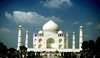 its
own to create unique works of architecture.
its
own to create unique works of architecture.
The Taj Mahal is often noted as a monument to love , but it can also
be seen as a fusion of architectural traditions and, as such, a monument
to multiculturalism.
This can be said about many Islamic structures and about many architectural
monuments butsome background on the Taj Mahal and this period reveals
that this is especially true here.