|
THE BASEMENT CHAMBERS AND
A PROBABLE THIRD GRAVE
Two staircases on the northern side of the red sandstone
plinth of the Taj lead below into the basement chambers which are
seventeen in number and have been laid out in a line on the riverside
of a narrow through-corridor. The rooms and corridor are of arcuate
construction in brick and plaster, with stucco and painting ornamentation,
distributed aesthetically on the soffits. At the extreme points
on both sides there are doors sunk in the northern wall. They were
blocked up permanently and securely with thick masonry at some unknown
date, undoubtedly for some well calculated purpose. As may be
surmised, the set on the northern side could have been repeated
on the sides below the marble structure, with a rotating corridor,
chambers and probably a crypt in the centre - all being interconnected.
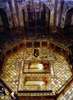
This crypt would have contained the third and the real set of
graves. The custom of providing cenotaphs or replicas had been
followed by the Turks and the Mughals alike as we meet with this
practice at the tomb of Iltutmish at Delhi and at the tombs of Saqid
Khan and Akbar at Agra. The tomb of Akbar has three tombstones,
one on the grave and two as cenotaphs. The tomb of Itmad-ud-Dauhlah
and Chini-ka-Rauza too had three tombstones each. The lowest of
the former was contained in a crypt which was originally accessible
from the riverside and has now been completely blocked up. These
examples indicate that the Mughals liked to provide three tombstones
in a mausoleum. At the Taj, the third is traditionally claimed
to exist. It is only in these underground vaults that the third
set could have been placed. The doors in the basement corridor
no doubt exist and must have originally given entry to some underground
arrangement of chambers and corridors. Though they are now impregnably
blocked, their existence lends weight to the legendary version.
 
|