|
DANCE AND FESTIVAL
MOHINIYATTAM
: Mohiniyattam, literally meaning ‘dance of the celestial enchantress’,
is very lyrical. The dance of delicate gracealso known as 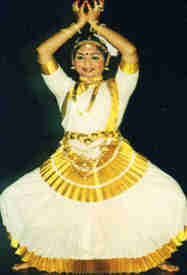 "Dasiattam"
. Lord Vishnu came to the rescue of the panic gods and assumed the female
form of an amorous celestial dame Mohini. Captivating the demons with
her charms, Mohini stole the elixir from them and restored it to the gods.
This dance was adopted by the Devadasi or temple dancers,
hence caled 'Dasiattam' which was very popular during the Chera reign
from 9th to 12th century. "Dasiattam"
. Lord Vishnu came to the rescue of the panic gods and assumed the female
form of an amorous celestial dame Mohini. Captivating the demons with
her charms, Mohini stole the elixir from them and restored it to the gods.
This dance was adopted by the Devadasi or temple dancers,
hence caled 'Dasiattam' which was very popular during the Chera reign
from 9th to 12th century.
The dance of the enchantress contains elements of Bharathnatyam as well
as the classical and folk dances of the state. Slow, graceful, swaying
movements of the body and the limbs and highly emotive eyes and hand gestures
are unique to mohiniyattam. It is performed as a solo dance and Mohiniyattom
is performed by women wearing gold-bordered off-white saris and gold jewellery,
their hair in a chignon high on one side of the head and encircled with
white jasmine flowers and her neck hangs the serpent figure and from ankles
brass bells tinkle and forehead wear vermilion.Maharaja Swathi Thirunal,
king of erstwhile Travancore, breathed fresh life into the dance form
making it popularand mohiniyattom along with other dance forms enjoyed
royal patronage during his regime.
Kalarippayatt : Kalaripayattu is based on the principle
of a sound mind in a healthy body and is one of the temple arts in South
India. In 4th century 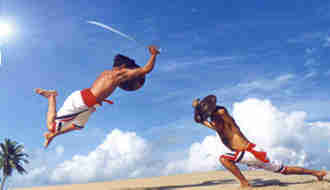 A.D
Bodhi Dharma a Buddhist monk spread Kalari payatt to Chinaand this art
reached its peak in the 16 the century under different kingdoms. Their
is a myth that sage Parasurama who built temples along south India introduced
this art. A.D
Bodhi Dharma a Buddhist monk spread Kalari payatt to Chinaand this art
reached its peak in the 16 the century under different kingdoms. Their
is a myth that sage Parasurama who built temples along south India introduced
this art.
Kalari - a type of gymnasium built according to the vastushasthra
giving each devathas (subtle beings or higher beings) its particular place.
In the southwest corner kalari there is a poothara (an altar) with seven
steps representing seven female powers including Bhadra Kali, and a Shiva
linga on its top. And the students who come to leran this atr perform
Pooja That will increase his concentration, which makes him proficient
rapidly. The art includes seven shasthras (sciences) like Vastu,
Jyothi, Marma, Ayurveda, Asana, Tantra and Mantra. The teacher
, Gurukkal gives the knowledge of Marmas which he has to his disciples.Besides
the physical training the disciple also receives the moral training. Kalaripayatt
is practised in many parts of Kerala. Different styles, methods of Payatts
exists, among them Vadakkan style's Thulunadan is considered as the highest.


|