|
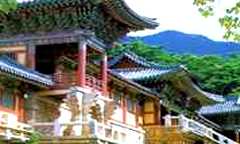
Pulguksa(Temple of the Buddha-land) was constructed in
751 in Kyongju, the capital of the ancient Shilla Kingdom(57
B.C.-A.D. 935), often called a museum without walls because
the whole area is dotted with Buddhist statuary and pagodas,
royal tombs, fortress ruins and other remains of one of
the golden eras of Korean culture. Pulguska has been designated
by the Goverment as Historic Site No. 1. It is renown not
so much fot its soze or age but because it is a flawless
example of Shilla architecture and because it enshrines
several of the most important Buddhist National Treasures.
According to legend, Kim Tae-song was reincarnated as the
son of a Prime Minister during Shilla because he had a virtuous
life as a good and faithful Buddhist in a previous life
where he had been the son of a poor widow. He was Prime
Minister for five years, after which he designed Pulguska,
so it is said, to honor the parents of his life in Shilla
and Sokkuram to honor the parents of his previous life.
Others say that they were built to honor the king. In any
case, construction of Pulguksa began in 751 and was completed
in 774. More than 80 of the original buildings were burnt
down during the Japanese invasion in 1593. Some of the buildings,
including Taeungjon, the principal shrine, were later reconstructed.
From 1969 to 1973, the original scale and some of the remaining
buildings were reconstructed.
|