|
King T'aejo(r.1392-1398), the founder-king of the Choson(1392-1910)
Kingdom had Chongmyo, the Royal Ancestral Shrine, built
in 1394, when the capital was moved from Songak(the present
Kaesong) to Hanyang(now Seoul). Construction begun in December
1394 and was completed in September, the following year.
The shrine has been continuously expanded over the years.
The main shrine was called Chongjon and a similiar building
constructed by King Sejong the Great(r.1418-1450) was called
Yongnyongjon(Hall of Eternal Peace). Besides these two shrines,
there are a number of auxiliary buildings.
The main hall, the longest wooden building in Korea, enshrines
49 memorial tablets of Yi Dynasty kings and queens in 19
cubicles. With its large stone terrace in the front, it
exudes a simple elegance and majestry. The Hall of Eternal
Peace contains 33 tablets in 16 cubicles and the Hall of
Meritorious Retainers 82 tablets of those who supported
the founding of the dynasty.
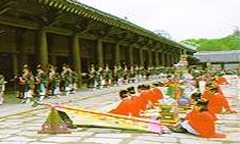
The memorial rites were held at the main shrine fve times
a year and at the Hall of Eternal Peace twice a year during
the Choson Kingdom. The rites were temporarily suspended
from 1945 to 1971, when the Yi clan of Chonju revived them.
They are now held once a year, on the first Sunday in May.
The rites are designated Important Intangible Cultural Property
No.55. the music performed during the rites includes that
in praise of the civil and military virtues of ancestors
which is performed along with a dance by 64 dancers. The
music is played by two orchestras, one on the elevated terrace
and the other in the lower court. The music is Important
Intangible Cultural Property No.1.
|