The Main Architects:
Though no one or two people can be credited with coming up with the
design for the Taj, the entire construction work was under the supervision
of two master architects, Makramat Khan and Mir Abdul Karim. An ode
to the finest of Safavid traditions, the Taj is all about perfect symmetry.
The classical perfection of its shape, the combination of monumentality
and delicacy, all are derived from the Persian roots of the Mughals.
But the use of the pure white marble from Makrana in Rajasthan have
infused the monument with a spirit that's uniquely Indian.
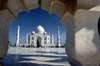 The
Structure: The Taj is set amidst geometrical gardens created
in the famous Persian Chahar Bagh style. The four intersecting water
channels symbolize Paradise with its four flowing rivers, as described
in the Koran.
The
Structure: The Taj is set amidst geometrical gardens created
in the famous Persian Chahar Bagh style. The four intersecting water
channels symbolize Paradise with its four flowing rivers, as described
in the Koran.
The octagonal structure of the tomb is topped by a breathtaking dome.
Set above arched recesses and carved balconies inlaid with precious
and semi-precious stones, the huge dome somehow seems light enough to
be floating on mist in the dusky evenings.
The Tomb: The tomb is square in
design, only the corners are chamferred off to break away from the angularity
of the previous structures. Set on a high marble plinth, the Taj is
set off by two identical red sandstone structures on both sides. At
each corner of the square plinth stands a slender minaret topped by
a Rajasthani chhatra (copula), supported by eight delicately carved
pillar.
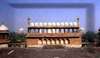 The
entrance to the long colonnade in front of the Taj lies through a main
gate in red sandstone inlaid with white marble. So huge is this structure
that it seems like a complete building in itself. The arched entrance
frames the whole monument, for a newcomer, in the most enchanting manner.
Inside, surrounded by delicately carved, eight feet high marble screens,
decorated with verses from Koran and flowery tendrils, are the cenotaphs
of the empress and the emperor.
The
entrance to the long colonnade in front of the Taj lies through a main
gate in red sandstone inlaid with white marble. So huge is this structure
that it seems like a complete building in itself. The arched entrance
frames the whole monument, for a newcomer, in the most enchanting manner.
Inside, surrounded by delicately carved, eight feet high marble screens,
decorated with verses from Koran and flowery tendrils, are the cenotaphs
of the empress and the emperor.