The actual tombs of the Shah and his wife rest within
the Taj itself. No shoes are allowed so all visitors must take them
off 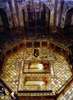 and
pay a small fee to workers to watch them before they enter. Socks are
recommended because the heat of the Indian sun makes the marble feel
hotter than a frying pan!
and
pay a small fee to workers to watch them before they enter. Socks are
recommended because the heat of the Indian sun makes the marble feel
hotter than a frying pan!
Inside, two stories of eight rooms surround a central echoing chamber
that rises 80 feet high to the dome. These rooms were originally used
for reciters of the Quran or for musicians who played soft Indian and
Persian melodies. he interior usually feels pleasantly cool and dark
after being in the outside heat. In the main chamber within the Taj,
an octagonal screen of marble surrounds the tombs more than six feet
in height. Originally when the tomb was first constructed, the screen
was made of gold. However in 1643, fearing vandals, Shah Jehan ordered
it replaced by marble. 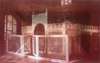
The Taj Mahal interior marble reliefs are of flowers that are strangely
in vases unlike the outside where they are just in bunches. This might
have been done to make the inner rooms special somehow. Flowers, especially
those in vases could have been symbols of the bounty promised to the
faithful in paradise. Within the screen, two marble cenotaphs (coffins)
lie side by side. These however, do not contain the actual bodies, which
are cryptically (no pun intended!) buried in the crypt below. Following
Islamic practice they are oriented longitudinally north to south with
their faces towards Makkah. Her cenotaph is in the center, while the
Shah's is to her right.
Pietra dura inlay work with precious and semi-precious stones of many
colors (sapphire, topaz and coral) cover the marble surface of the screen
and the cenotaphs in the form of graceful flowers, delicate arabesques
and superb calligraphy. The many guards standing with rifles protect
the jewels from anyone wanting to take home priceless souvenirs. Gazing
at the inside makes one imagine how the outside of the Taj might have
looked in its original glory, before according to most Indians the British
absconded with  much
of the treasured stones on the outside edifice.
much
of the treasured stones on the outside edifice.
Many of the decorations in the inner chamber are made from transparent
marble, which you can see by placing your hand behind one. Both cenotaphs
are quite similar except that the calligraphy on Mumtaz's includes verses
from the Quran.
 On
either side of the Taj Mahal are buildings of red sandstone. The one
to the west is a Mosque. It faces towards Makkah and is used daily for
prayer. On the outside, the Mosque has Pietra dura work twining across
and a red sandstone platform in front.The floor of the Mosque is of
exceedingly fine and sparkling material that appears velvet red in shade.
On
either side of the Taj Mahal are buildings of red sandstone. The one
to the west is a Mosque. It faces towards Makkah and is used daily for
prayer. On the outside, the Mosque has Pietra dura work twining across
and a red sandstone platform in front.The floor of the Mosque is of
exceedingly fine and sparkling material that appears velvet red in shade.