 |
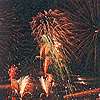
Kumano Fireworks Festival
Mie prefecture, July and August
Fireworks are essential to summer in Japan. In Mie prefecture,
displays of fireworks take place at many seaside places in
July and August. The Kumano Fireworks Festival (8/17) started
about 300 years ago to comfort spirits, still attracts a large
number of tourists from all over Japan every year. It is extremely
exciting to see Kaijo Jibaku, shooting up fireworks on the
sea, or fireworks shot up towards the vast expanse of the
ocean with Onigajo in the background.
|
 |
Fireworks Display
Shirahama Bay, Wakayama Prefecture, July 30 &
August 10, 2000
A tremendous display of 1,000 skyrockets and fireworks over
Shirahama Bay.
|
 |
Awa Odori
Tokushima Prefecture, 12 - 15 August , 2000
Imagine a river of thousands of elaborately dressed men, women
and children dancing and prancing to the rhythm of pounding
drums, high-pitched bamboo flutes and a variety of other traditional
Japanese instruments every night from August 12 to 15 in Tokushima
City. This is Awa odori, the Dance of Awa. The enticing atmosphere
created by the Awa Odori Carnival brings people back to Tokushima
year after year.
|
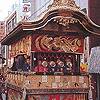 |
Ueno Tenjin Festival
Iga Town, Mie Prefecture, 23-25th October, 2000
With a history of about 400 years, this festival features
merry parades of Mikoshi portable shrines, Onigyoretsu ogres
procession, Shichifukujin Odori seven dancing Gods, and nine
Danjiri carrier portable shrines, all accompanied by traditional
festival music.
|
| |
Shichi-Go-San
November 15
In Japan, children who are three, five, or seven years old
are thought to be especially lucky. So, on November 15, families
who have children of these ages take part in a very old festival.
This special children festival is called Shichi-Go-San, or
Seven-Five-Three. It is for boys and girls who are three,
five, or seven years old.
On this day, the children dress in their finest clothes.
Some wear Western-style clothes. Others follow the old customs.
They wear traditional kimonos, which are beautiful, brightly
colored robes made of cotton or silk. And every child has
a long, narrow paper bag. On each colorfully decorated bag
there are pictures, usually of a pine tree, a tortoise, and
a crane. These are symbols of youth and long life. When everyone
is ready, the families go to a shrine, or place of worship.
There, they give thanks for the good health of the children.
They also ask for a blessing for the future health and happiness
of the children.
Outside the shrine, there are stalls where the parents buy
candy and toys to fill the children paper bags. After the
families return home, the children give some of their candy
to visiting friends and relatives. In return, the children
are often given gifts. Finally, the day may end with a party.
Truly Shichi-Go-San is a very special day for a child of three,
five, or seven!
|
| |
Ako Loyal Samurai Festival
Ako City, Nara Prefecture, December 14
A parade where people in feudal costumes march through the
street. This festival is based on a true life story from the
Edo period.
|
|